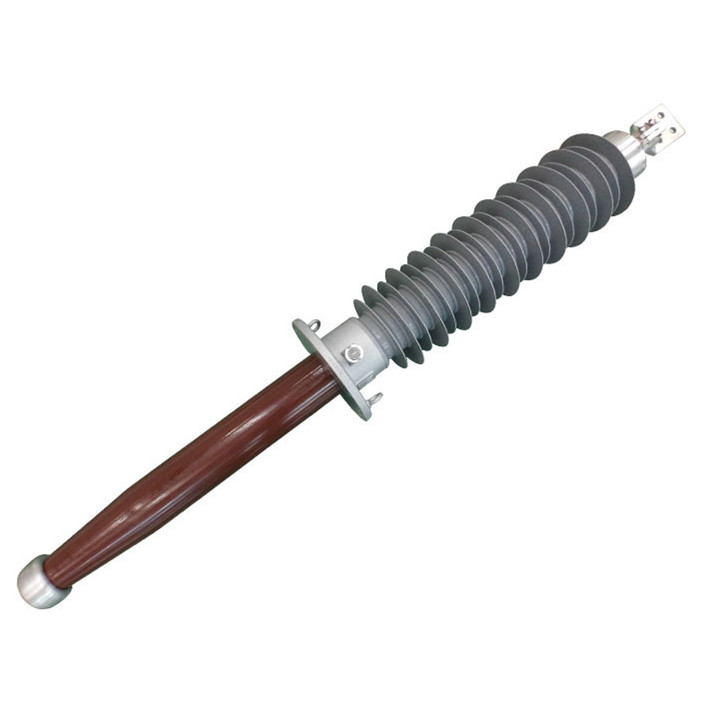




An oil-to-oil bushing carries a conductor between two oil-filled compartments while providing electrical insulation from the grounded mounting structure. NJREC offers oil-to-oil transformer bushings with RIP or RIS condenser cores for power transformers and oil-filled transition enclosures. Our oil-to-oil bushings are available in voltage ratings from 72.5 to 550 kV under IEC standards and 69 to 500 kV under IEEE standards, with rated currents up to 2500 A.

The cross-section identifies the conductor, RIP/RIS-based condenser core, flange, test tap, glass-fiber layer and anti-corona shields on the cable and transformer sides.
IEC 60137:2017. Voltage classes below are equipment highest voltages (Um), not nominal system voltages.
| Parameter | Unit | 72.5 | 100 | 123 | 145 | 170 | 245 | 300 | 362 | 420 | 550 |
|---|---|---|---|---|---|---|---|---|---|---|---|
| Highest voltage for equipment, Um | kV | 72.5 | 100 | 123 | 145 | 170 | 245 | 300 | 362 | 420 | 550 |
| Rated frequency | Hz | 50/60 for each voltage class | |||||||||
| Dry power-frequency withstand voltage, 1 minute | kV | 155 | 205 | 255 | 305 | 355 | 505 | 505 | 560 | 695 | 750 |
| Lightning impulse withstand voltage (BIL) | kV | 325 | 450 | 550 | 650 | 750 | 1050 | 1050 | 1175 | 1425 | 1675 |
| Switching impulse withstand voltage (SIL) | kV | – | – | – | – | – | 850 | 850 | 950 | 1175 | 1300 |
| Maximum rated current | A | 2500 for each voltage class | |||||||||
| Temperature range | °C | Down to −60 °C; up to +55 °C available on request | |||||||||
IEEE C57.19.01:2017. Voltage classes below are equipment highest voltages (Um), as labeled in the product data.
| Parameter | Unit | 69 | 115 | 138 | 161 | 230 | 345 | 500 |
|---|---|---|---|---|---|---|---|---|
| Highest voltage for equipment, Um | kV | 69 | 115 | 138 | 161 | 230 | 345 | 500 |
| Rated frequency | Hz | 50/60 for each voltage class | ||||||
| Dry power-frequency withstand voltage, 1 minute | kV | 160 | 260 | 310 | 365 | 425 | 520 | 750 |
| Lightning impulse withstand voltage (BIL) | kV | 350 | 550 | 650 | 750 | 900 | 1175 | 1675 |
| Switching impulse withstand voltage (SIL) | kV | – | – | – | – | – | 825 | 1175 |
| Maximum rated current | A | 2500 for each voltage class | ||||||
| Temperature range | °C | Down to −60 °C; up to +55 °C available on request | ||||||


The conductor provides an electrical path between the connected oil-filled compartments.
The RIP/RIS condenser core separates the energized conductor from the grounded flange and controls the electric field along the bushing.
The mounting flange positions the bushing at the equipment interface, while the end shields form part of the electrical design on the cable and transformer sides.
Oil-to-oil bushings are used in power transformers and rectifier transformers to provide an insulated electrical connection between two oil-filled sections. They allow conductors to pass through barriers separating the transformer main tank from other oil-filled compartments, such as oil-filled transition enclosures and connection chambers.
In these applications, oil-to-oil bushings provide reliable current transmission while maintaining electrical insulation and separation between the oil-filled sections.
NJREC provides IEC and IEEE rating tables for this oil-to-oil bushing so engineers can compare voltage class, withstand levels and maximum rated current in one place.
An oil-to-oil bushing connects two oil-filled sections. An oil-to-SF6 bushing connects an oil-filled section to an SF6-filled section. The connection media and interface design must match the equipment.
The product table lists equipment highest voltages (Um) of 72.5–550 kV for IEC and 69–500 kV for IEEE. It lists a maximum rated current of 2500 A at every shown voltage class.
No. Oil-to-oil refers to the insulating media on both sides of the bushing, not the condenser core material. NJREC offers both RIP and RIS condenser cores, depending on your specific application requirements.
