
1. Voltage class
The system level the bushing is rated for. Published classes on this product are 5, 8.7, 15, 18, 25, 30/34 and 34.5 kV. Buyer decision: match the transformer's highest system voltage, not the nominal operating voltage of the feeder.

Four numbers decide whether a bushing survives its duty: voltage class, BIL, continuous current and cantilever load. This page sets out what to confirm with an ANSI bushing manufacturer before a drawing is released, and what a transformer bushing supplier should be able to document from the published electrical data table.

Envelope at a glance: rated 5–34.5 kV · BIL 75–200 kV · continuous current 30–1600 A · wet-process porcelain, one piece up to 2800 mm.
Four numbers have to be satisfied at the same time. Under-specify any one of them and the bushing either fails its impulse duty, runs hotter than intended, or cannot physically be bolted to the conductor that arrives on site.
The system level the bushing is rated for. Published classes on this product are 5, 8.7, 15, 18, 25, 30/34 and 34.5 kV. Buyer decision: match the transformer's highest system voltage, not the nominal operating voltage of the feeder.
The lightning impulse withstand the insulation is designed for. Published values are 75, 95, 110, 125, 150 and 200 kV. Buyer decision: BIL is the number that most often changes the physical envelope, because it drives porcelain height and creepage.
The current the bushing carries indefinitely. The published electrical data table lists classes from 30 A to 1600 A. Buyer decision: size on the transformer's rated current plus margin, then confirm the terminal hardware accepts the conductor.
The bushing is produced to withstand high mechanical forces such as inner pressure and cantilever loading, one reason for the one-piece wet-process porcelain construction. Buyer decision: check the conductor's static and short-circuit loads before specifying a long body.
BIL is the first. Teams match voltage class and current from a one-line diagram, then inherit a lower impulse level than the site actually requires. The terminal thread and hole pattern is the second: it is often left to the installation crew and discovered only when the cable lug does not fit. Both are cheap to fix on the drawing and expensive to fix at commissioning.
The extract below republishes rows from the product page's electrical data table, sorted by voltage class, so a specifier can jump straight to the class in question instead of scanning a long table.
| Voltage class | BIL | Connection option (published) | Current shown |
|---|---|---|---|
| 5 kV | 75 kV | SPADE CONNECTOR | 170 A |
| 8.7 kV | 95 kV | SPADE CONNECTOR | 1600 A |
| 15 kV | 95 kV | 11/32″ EYEBOLT | 125 A |
| 18 kV | 125 kV | 7/16″ EYEBOLT | 125 A |
| 25 kV | 150 kV | 2 HOLE SPADE | 417 A |
| 30/34 kV | 150 kV | 2 HOLE SPADE | 208 A |
| 34.5 kV | 200 kV | #2 SOL – 1000 MCM conductor entry | 800 A |
| 34.5 kV | 200 kV | 1 1/8″ TERMINAL POST | 800 A |
The product page also carries a summary specification line listing a 15–27 kV rated voltage. Treat it as a mid-range headline figure: the full electrical data table is the selection reference and covers 5 kV through 34.5 kV, with 110 kV BIL entries also published alongside 75, 95, 125, 150 and 200 kV. Current classes run across the full 30 A–1600 A span. Always select the individual row that matches your design rather than the headline figure, and confirm the exact row against the product page before releasing a part number.
The electrical rating decides what the bushing can carry. The terminal decides whether you can actually connect it. Work through the mechanical interface before you finalise the rating row.
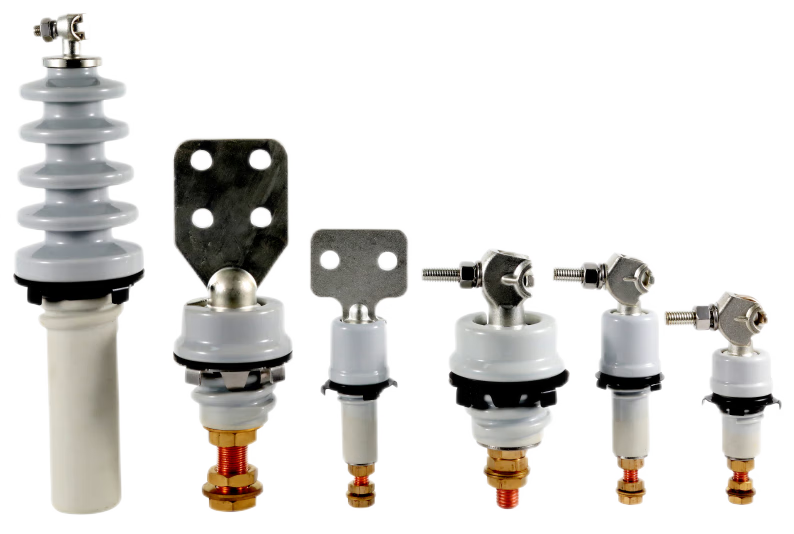
A flat spade land for a bolted bus-bar or lug connection. It appears across the published table from the 5 kV class through to the 8.7 kV high-current row. Choose it when: the mating bus bar or lug is flat and the joint is bolted.
A threaded eyebolt stud, published in 11/32″, 7/16″, 5/8″, 15/16″ and 1 1/8″ sizes. The 15 kV and 18 kV rows in the extract use this family. Choose it when: a cable lug needs to slip over a stud and be nutted down.
Multi-hole spade lands for higher-current bolted joints. Choose it when: the hole count must match the number of bolts in the mating bus bar — a mismatch is a field modification, not a drawing change.
Listed alongside the other connector options in the published electrical data table. Choose it when: your standard hardware is a threaded stud connection — confirm the thread size on the order, since the published range runs from 11/32″ to 1 1/8″.
A threaded sidewall connection option named in the published table. Choose it when: the connection leaves at an angle — agree the mating thread size in writing, because the published sizes are not interchangeable.
A stud terminal post, published at the 34.5 kV / 200 kV BIL / 800 A row in a 1 1/8″ size. Choose it when: a large stud and a heavy conductor need the highest mechanical security at the top of the range.
| Interface parameter | Published values |
|---|---|
| Eyebolt / terminal post thread sizes | 11/32″, 7/16″, 5/8″, 15/16″, 1 1/8″ |
| Spade thickness | 3/8″ thick |
| Spade hole counts | 1, 2, 4, 6 and 8 hole spade |
| Conductor range (one published entry) | #2 SOL – 1000 MCM |
| Terminal families named in the data table | SPADE CONNECTOR, EYEBOLT, EYEBOLT CONNECTOR, 1/2/4/6/8 HOLE SPADE, SIDEWALL THREADED, TERMINAL POST |
Once the rating row is fixed, the configuration questions decide whether the part actually fits the tank, the enclosure and the installation programme.
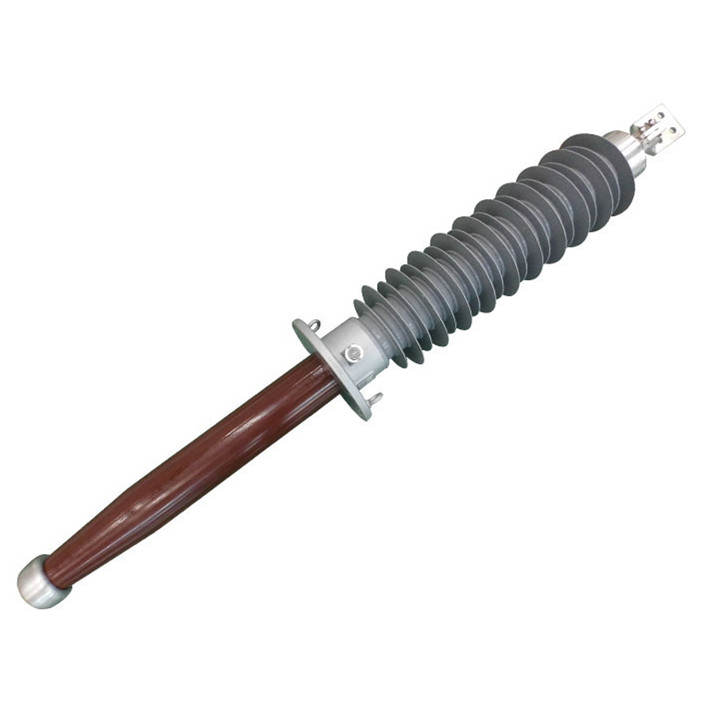
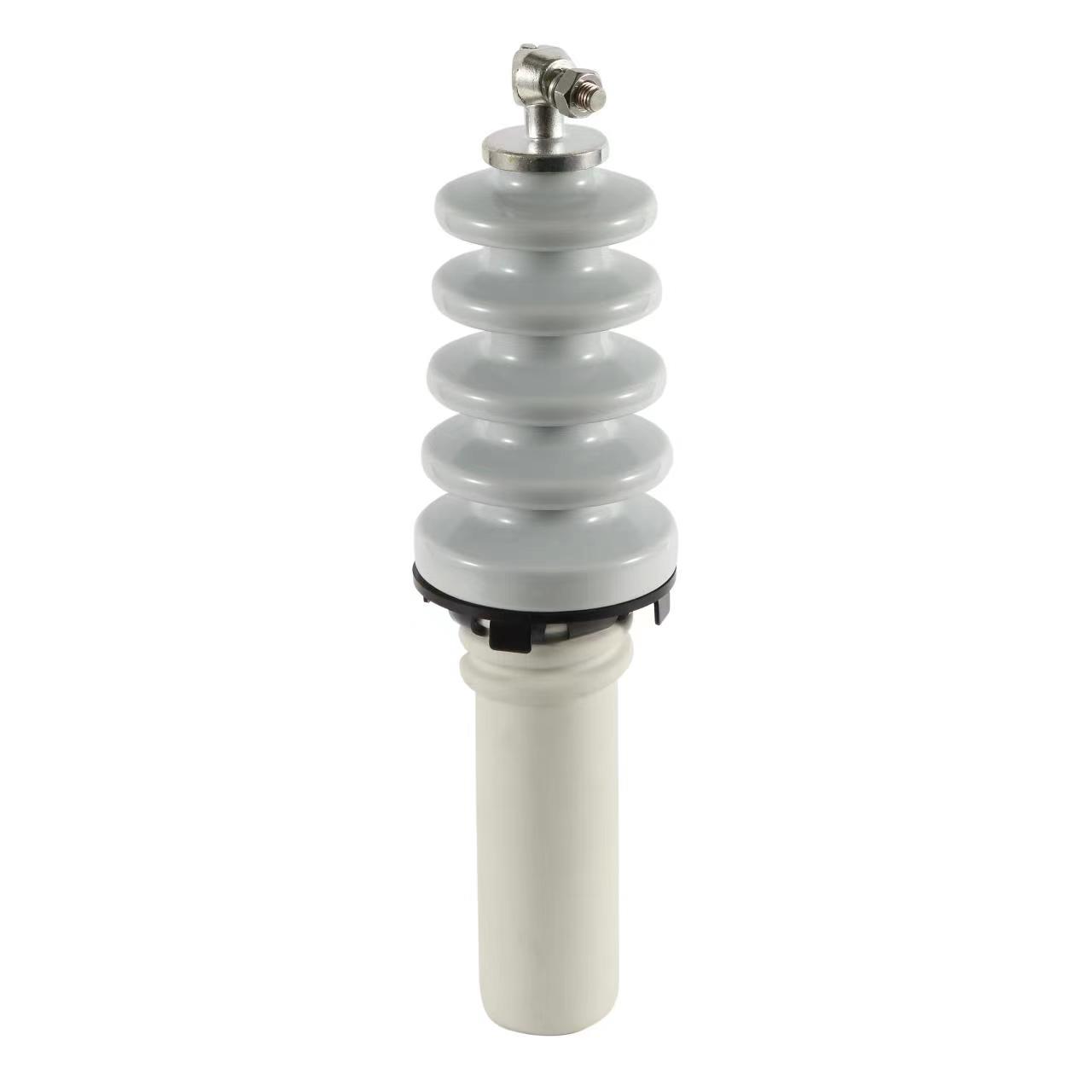
The body is a wet-process porcelain insulator with a light gray glaze, produced in one piece up to a maximum length of 2800 mm. Decision: one-piece construction avoids a jointed interface, so plan your layout inside that ceiling rather than assuming a jointed assembly.
The product page lists compatibility with oil-immersed power transformers. Decision: confirm the length required inside the tank and the oil-side clearance before releasing the drawing.
Dry-type power transformers are also listed as compatible. Decision: check the air-side clearance and the creepage the BIL class demands, since there is no oil to assist insulation.
Both application contexts are named on the product page. Decision: confirm the short-circuit and cantilever loads expected at the specific site, not just the network class.
The bushing supports both new installations and retrofit projects. Decision: on a retrofit, measure the existing hardware and terminal thread first — matching the old interface usually saves more time than re-engineering the connection.
Wet-process porcelain ANSI bushings are one family in a wider range that also includes OIP and RIP condenser bushings and high-current bushings. Decision: settle the family before comparing individual rating rows — the matrix below links the alternatives.
One-piece production up to 2800 mm covers a large share of ANSI distribution and substation bushings, but it is a hard figure. If your voltage class, BIL and required external creepage push the body past that length, raise it early in the design conversation rather than after the outline drawing is issued.
Two standards frameworks shape how a bushing is specified, and the porcelain body here is produced against both.
The product is stated to conform to ANSI electrical insulation standards, and the specification block lists ANSI as the standard. The published rating data is presented in ANSI terms — voltage class, BIL and continuous current — so the selection matrix and the documentation use the same vocabulary.
Porcelain insulators are produced according to IEC, ANSI and customer standards, and the insulators are available in cylindrical, conical or straight inner and outer profiles. Buyer decision: state on the enquiry which standard governs the project and which document revision you need issued.
A PDF format document is available from the product page, alongside the electrical data table. Buyer decision: attach the revision you build to in the design file so the rating row and the terminal description stay traceable.
Four common project situations, each mapped to a published rating combination and the decision that actually slows projects down.
Published combination to match: 15 kV / 95 kV BIL / 125 A with an 11/32″ or 7/16″ eyebolt.
Buyer decision: measure the existing cable lug before ordering. Reusing the old lug normally fixes the thread size, and that single measurement is what decides between the two published eyebolt options.
Published combination to match: 34.5 kV / 200 kV BIL / 800 A with a 1 1/8″ terminal post, or the conductor entry listed as #2 SOL – 1000 MCM.
Buyer decision: the conductor range drives the terminal, not the other way round. Confirm the actual conductor size and lug type before choosing between the terminal post and the conductor-entry option.
Published combination to match: 8.7 kV / 95 kV BIL / 1600 A with a SPADE CONNECTOR.
Buyer decision: at this current the mechanical joint matters as much as the rating. Check the spade land thickness, published as 3/8″ thick, and the hole count against the bus bar you intend to bolt to.
Published configuration to match: wet-process porcelain with light gray glaze, one piece up to 2800 mm, listed as compatible with dry-type transformers.
Buyer decision: BIL and creepage sets the body length, so lock the BIL class before you commit to a clearance dimension. Confirm the overall length stays inside the 2800 mm one-piece limit.
Selection support is offered directly for this product, and custom porcelain can be produced to IEC, ANSI or customer standards. Send the following and the rating row can be confirmed without a second round of questions.
The product page also carries an Add to Inquiry option next to item number 00354 and a PDF format document download for the published data.
Keep adjacent product options together for a faster catalog comparison.

Tailored manufacturing for OIP capacitive bushing units. We provide high-current HV condenser bushing solutions, 24-800kV, optimized for diverse power networks.
View product
Oil-free structure featuring resin impregnated paper condenser bushing tech. This RIP capacitive bushing provides high dielectric stability for HV substations.
View product
Dry-type RIP Capacitive Bushing with porcelain or composite shell, oil-free insulation, rated for 24–1100 kV in safe electrical bushing installations.
View productthe electrical data table covers voltage classes of 5, 8.7, 15, 18, 25, 30/34 and 34.5 kv, bil values of 75, 95, 110, 125, 150 and 200 kv, and continuous currents from 30 a to 1600 a. a 15–27 kv rated voltage line also appears as a summary figure; the electrical data table is the selection reference.
it uses a wet-process porcelain insulator with a light gray glaze, and is produced in one piece up to a maximum length of 2800 mm.
published connection options include spade connector, eyebolt, eyebolt connector, 1, 2, 4, 6 and 8 hole spade, sidewall threaded and terminal post. published thread and hole sizes are 11/32″, 7/16″, 5/8″, 15/16″ and 1 1/8″, spade thickness is given as 3/8″ thick, and one entry lists a conductor range of #2 sol to 1000 mcm.
yes. the product page lists compatibility with oil-immersed and dry-type power transformers, substations and distribution networks, and states support for both new installations and retrofit projects.
the bushing conforms to ansi electrical insulation standards, and the porcelain insulators are produced according to iec, ansi and customer standards.
use the request quote option or the add to inquiry button beside item number 00354 on the product page, or contact the team directly for support with product selection. a pdf format product document is also available from the product page.

